Table of Contents
About the Author

More Posts


A lot of business owners say the same thing.
Family matters most. Marriage matters. Church matters. Leadership matters. Strategy matters.
And most of them mean it. But then you look at the calendar, and the calendar tells a different story.
Your calendar may be more honest than your intentions
Most owners don’t need to be convinced that these things matter.
They already know their marriage deserves more than leftovers. They know their children need more than provision. They know church is not supposed to be treated like an optional accessory to a productive life. They know leadership and strategy are part of their actual job as the owner.
But the week fills up anyway.
Customer fires show up. Employee questions interrupt the work that was supposed to matter. The inbox pulls them into cleanup mode. Last-minute approvals, customer requests, estimates, follow-ups, and operational loose ends slowly take over the schedule.
By Friday, the owner is exhausted. And even if he doesn’t say it out loud, he knows there’s a gap between what he says matters and what his time proves matters.
That gap isn’t just a productivity issue. It’s a leadership issue. And for the Christian owner, it may also be a trust issue.
The problem is not that you don’t care
You can care deeply about the right things and still fail to lead your time toward them.
That’s what makes this so uncomfortable. Most owners are not neglecting family, church, leadership, or strategy because they despise those things. They are neglecting them because they keep assuming they will get to them after the business calms down.
After this busy season. After the next hire. After cash flow improves. After the team needs less from them. After customers stop asking for so much.
But what if the business never naturally gives you that time?
What if the time has to be made, protected, and defended?
For the last few years, this sounded a lot like me. I would have told you my family mattered most. My marriage mattered. My children mattered. My church mattered. Honoring my parents mattered. And I meant all of it.
But if you looked at my actual time and energy, the story was different. I was working more hours and sleeping less than at any other point in my career. I kept telling myself it was just a season, and if I could push hard enough now, grow the business enough now, then eventually I would earn the right to give more time to the people and responsibilities I said mattered most.
But honestly, I don’t think that is how God’s economy works.
Fear often hides underneath the calendar
A disordered calendar often reveals a fearful assumption.
The assumption sounds something like this: If I actually spent my time the way I believe is ideal and biblical, I’m not sure the business would survive.
That’s the part we usually don’t want to say out loud. We believe the principle. We agree that a well-ordered life is good. We know family, church, leadership, strategy, and rest should not always get whatever is left after the business is done taking its share.
But when it comes time to actually block the calendar, fear starts talking.
What if I miss an opportunity? What if the team drops the ball? What if customers get frustrated? What if revenue slows down? What if I am the lynchpin and everything starts to fall apart without my constant attention?
That fear may feel responsible. It may even feel noble. But Jesus does not tell us to organize our lives around anxiety.
In Matthew 6, He tells us not to be anxious about our life, what we will eat, what we will drink, or what we will wear. He reminds us that our Father knows what we need. Then He says, “seek first the kingdom of God and his righteousness, and all these things will be added to you.”
That is not a call to be careless. It’s a call to stop living like everything depends on your ability to violate the other priorities God gave you.
Honor God with the firsts
You cannot give God the leftovers and call it trust.
Proverbs 3 says:
Honor the Lord with your wealth
and with the firstfruits of all your produce;
then your barns will be filled with plenty,
and your vats will be bursting with wine.
That passage is talking about wealth and produce, but the principle reaches deeper than money. Honor God with the firsts. Not the scraps. Not the exhausted end of the day. Not the “someday when this business is finally easier” version of your obedience.
For me, things did not begin to change when I finally felt like I could afford the time. They began to change when I started making the time first, even when every fiber of my being screamed that I couldn’t afford it.
And strangely enough, that is when the business actually began to grow.
Not because I hacked my calendar perfectly. Not because everything suddenly got easy. But because I stopped pretending that obedience had to wait until the business felt safe.
Build the week you say you believe in
The first step isn’t to shame yourself.
The first step is to tell the truth.
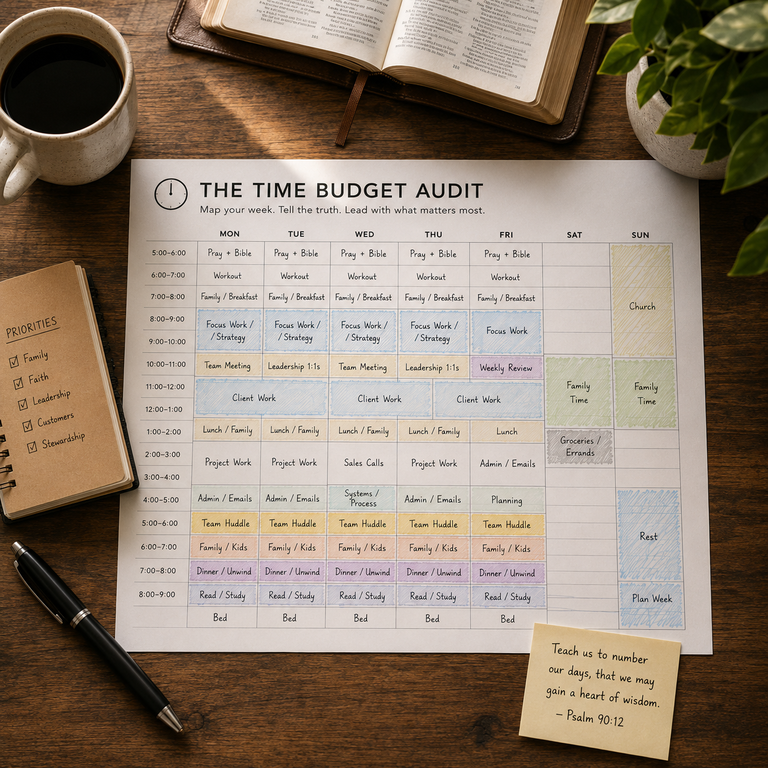
That’s why I put together a free resource called The Time Budget Audit. It’s a simple worksheet designed to help you compare what you say matters with how your week is actually being spent.
The exercise is straightforward. First, you name the priorities you say matter most: family, marriage, church, leadership, strategy, rest, and the owner-level work you’re actually responsible to lead. Then you sketch what a faithful weekly rhythm could look like if you were not afraid of the consequences.
Not a fantasy week. Not a beach vacation pretending to be a calendar. Not some unrealistic schedule where nothing hard ever happens.
A faithful week.
Then you pull up last week’s calendar and compare the two. Where do they match? Where is the gap obvious? Where did urgency take over? Where did fear make the decision before you ever named it?
Again, don’t use the gap to beat yourself up.
Use it to lead yourself.
Choose one protected block this week and defend it like it actually matters.
Because it does.
Your time budget is telling a story
Your stated priorities matter, but your schedule is where those priorities become visible.
You may say family matters. You may say church matters. You may say leadership and strategy matter. But your time budget is telling a story too.
The goal is not to create a perfect calendar. The goal is to bring your real week into greater alignment with what you say you believe.
That will require planning. It will require courage and trust.
Not trust that the business will never have problems. Trust that God is not honored by a life where every other calling gets postponed until the business finally stops asking for more.
So start with one block. Put it on the calendar. Defend it.
Then keep going.
To thriving,

P.S. If you want help doing this, download the Time Budget Audit. It will walk you through a simple process to name your stated priorities, build a faithful weekly time budget, compare it against last week’s actual calendar, and choose one protected block to defend this week.