Table of Contents
About the Author
More Posts

You can be exhausted and still not be doing the work that actually produces a harvest.
Your calendar can be full, your days can feel slammed, and yet when you step back and look at the results, the field looks strangely thin.
At some point you have to ask a harder question than, “Am I busy?” You have to ask, “Am I actually working my land?”
The uncomfortable question Proverbs 28:19 asks
Proverbs 28:19 puts it like this:
Whoever works his land will have plenty of bread,
but he who follows worthless pursuits will have plenty of poverty.
That proverb slices right down the middle of our schedules. It does not say, “Whoever is busy will have plenty of bread.” It does not say, “Whoever feels stressed, or tired, or overwhelmed will have plenty of bread.”
It says, whoever works his land.
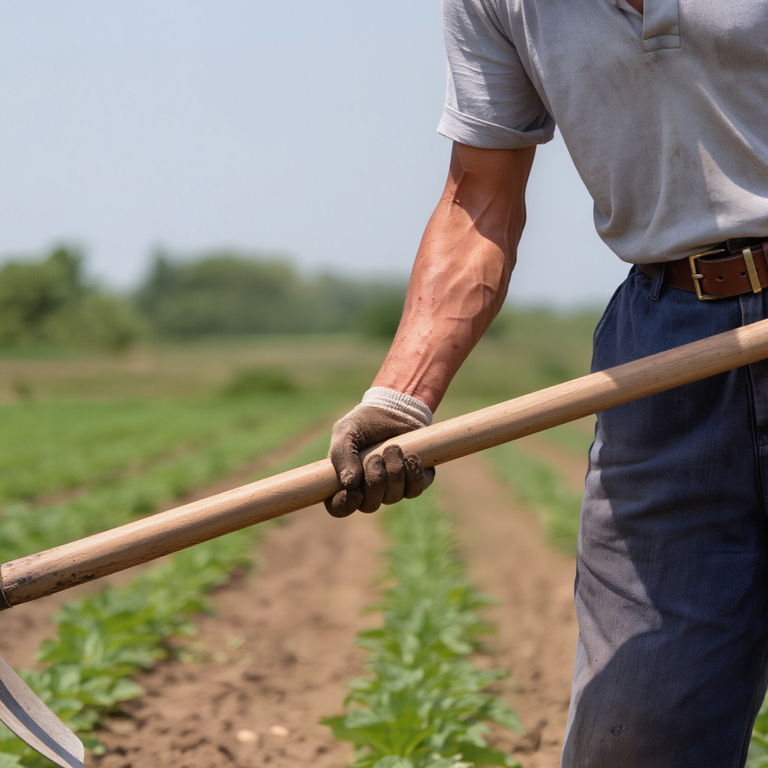
In other words, whoever spends his time and energy on the actual plot of ground God has given him to tend - that man will usually see a harvest over time. The one who chases worthless pursuits will not.
My calendar told one story, my results told another
Recently I had to admit something uncomfortable.
If you looked at my calendar, you would probably say, “Wow, Zach is busy.” I have been building systems, refining processes, tweaking tools. None of that is evil. Much of it matters.
But when I stepped back and looked at the results I said I wanted most, the picture didn’t line up.
For a long while, one of my deepest desires has been to serve more men and grow my client base. That is the “land” I say I want to work. But if you followed me around for a week, you wouldn’t have seen much time actually spent doing the kind of work that tends to create new clients.
I was moving dirt around on the edges of the field, not really working the land.
That realization was simple and painful at the same time. I had to admit that my effort and my desired outcomes had drifted apart.
Most men are not lazy, they are mis-aimed
Here is the thing. Most of the men I work with are not sluggards.
They are not sitting on the couch all day. They are not refusing to work. They are putting in long hours, carrying real responsibility, and coming home tired.
But often, they are tired from pouring energy into things that do not usually produce a harvest.
The emails that do not really matter. The meetings that feel urgent but rarely change anything. The tinkering with systems, tools, or ideas that keep us feeling productive without forcing us to face the work we are actually called to do.
So the problem is not “no work.” The problem is the wrong work.
The proverb calls those misdirected efforts “worthless pursuits.” Not because they are always sinful in themselves, but because they do not tend to produce the bread we are praying for.
Working the land you actually want to harvest
If you say you want a stronger marriage, then working your land probably looks like real, present time with your wife, hard conversations you have been avoiding, prayer together, and practical acts of service.
If you say you want deeper relationships with your kids, then working your land looks like unhurried presence, entering their world, correcting with patience, and training them with intention.
If you say you want a healthier business, then working your land looks like doing the things that actually move revenue, serving your best clients, and building a solid pipeline - not just adjusting fonts on your proposal template.
The question is not, “Am I doing things?” The question is, “Are these the kinds of things that, under God, tend to produce the harvest I say I want?”
That is what it means to work your land.
Our effort matters, but we do not control the harvest
There is a ditch on either side of this proverb.
One ditch says, “If I just grind hard enough, I can guarantee the outcome.” That is the lie of self-sufficiency, and it collapses under even a little bit of real life. You do not control the rain, the wind, the economy, the decisions of other people, or the mysteries of God.
The other ditch says, “Well, God is sovereign, so it does not really matter how I spend my time.” That is not what Scripture teaches either. Over and over we are told to be faithful, to be diligent, to sow, to plant, to water.
The healthy middle is this: We work our land, and we trust God for the increase.
Your job is not to manufacture the harvest. Your job is to be faithful with the specific field he has given you. To show up. To do the right work, in the right direction, over a long period of time.
If there is no harvest at all, it is worth asking whether there is a faithfulness problem. But do not confuse “I have not seen the harvest yet” with “I should not bother working the land.” Sometimes the fruit just takes longer to grow.
A simple exercise for the next 30 minutes
Let me invite you to do something concrete in the next day or so.
Set aside 20 to 30 quiet minutes with a pen and paper. Walk back through your last week as honestly as you can remember it. Do not write down what you intended to do. Write down what you actually did.
Then, for each major block of time, ask two questions:
- Is this really the kind of work that, under God, tends to produce the bread I am praying for?
- If not, what land has God given me that I need to work more faithfully this coming week?
You may find that most of your effort is already on target. Praise God for that and keep going. If you need encouragement to keep going when faithful work feels slow, take a look at Building a business is a marathon, not a sprint
Or, you may find a painful gap between what you say you want and what you actually do. If that is the case, do not hide from it. Bring it into the light before the Lord. Confess where you have chased worthless pursuits. Ask him to help you realign your effort with the results you are asking him for. On intentionally working on the business God has given you: If you are realizing you have spent a lot of time working in your business but not much time working on it, you might revisit How to take the first step in growing your business
You cannot fix everything in one week. But you can start working your land again, on purpose, today.
To thriving,
Zach